THINKING PATHWAYS
  • Home
  • Educational Resources
    • Thinking Routines >
      • Routines for Introducing & Exploring Ideas >
        • See Think Wonder
        • Think Puzzle Explore
        • Chalk Talk
        • Zoom In
        • 3 2 1 Bridge
        • Compass Points
        • The Explanation Game
        • Hot Spots
      • Routines for Synthesising & Organising Ideas >
        • Connect Extend Challenge
        • Colour Symbol Image
        • Headlines
        • I used to think...Now I Think
        • Generate Sort Connect Elaborate
        • The 4C's
        • The Microlab Protocol
        • E3
      • Routines for Digging Deeper into Ideas >
        • What Makes You Say That?
        • Circle of Viewpoints
        • Step Inside
        • Red Light Yellow Light
        • Claim Support Question
        • Tug-Of-War
        • Sentence Phrase Word
        • Peel The Fruit
        • Question Starts
        • Main Side Hidden
        • Layered Inference
      • Routines for Giving Feedback >
        • Give 3
        • Ladder of Feedback **NEW**
        • SAIL: Share Ask Ideas Learned **NEW**
      • Routines for Self Reflection >
        • Pause Points **NEW**
        • Success Criteria Strips **NEW**
        • Exit Ticket Questions
        • Traffic Light Reflection
        • Show of Thumbs Reflection
        • 3 2 1 Reflection
        • 4-Square Criterion Reflection
      • Routines for Engaging With Others **NEW** >
        • Give One Get One
        • +1
        • Think Talk Open Exchange
        • The Leaderless Discussion **NEW**
        • Making Meaning **NEW**
    • Cultures of Thinking >
      • Our Journey
      • Uncovering Student's Thinking
      • Building Understanding
      • 8 Cultural Forces >
        • Time
        • Routines
        • Language
        • Modeling
        • Opportunities
        • Interactions
        • Environment
        • Expectations
    • Inquiry-Based Learning >
      • Unpacking the Cycle of Inquiry **NEW**
      • The Art of Questioning **NEW**
      • Planning An Inqury Unit **NEW**
      • Genius Hour
    • Visible Learning >
      • Learning Intentions
      • Success Criteria
      • Feedback
      • 10 Mindframes for Visible Learning
    • Units of Work >
      • English >
        • Reading Resources >
          • Reading Conferences
          • Book Club
          • Visual Literacy
          • Book Review
        • Spelling Resources >
          • Spelling Through Inquiry
        • Grammar & Punctuation Resources
      • Mathematics >
        • Number & Algebra
        • Measurement & Geometry
        • Statistics & Probability
      • Science & Technology >
        • Earth and Space >
          • ES: Early Stage 1
          • ES: Stage 1
          • ES: Stage 2
          • ES: Stage 3
        • Material World >
          • MW: Stage 1
          • MW: Stage 2
          • MW: Stage 3
        • Living World >
          • LW: Early Stage 1
          • LW: Stage 1
          • LW: Stage 2
          • LW: Stage 3
        • Physical World >
          • PW: Stage Two
        • Digital Technologies >
          • DT: Stage 1
          • DT: Stage 2
          • DT: Stage 3
      • Geography >
        • S1: People and Places
        • S3: Factors That Shape Places
        • S3: A Diverse and Connected World
      • History >
        • The Australian Colonies
        • Australia As A Nation
      • Personal Development, Health & Physical Education >
        • PDHPE: YEAR 5
      • Other KLA's >
        • Creative Arts
        • ICT >
          • Google Apps For Education
  • Blog
  • SPEAKER
  • Podcasts
    • Teacher Takeaway Podcast
  • Books
    • The Thinking Classroom >
      • TTC Exclusive Content
    • The Learning Classroom >
      • TLC Exclusive Content
  • Shop
  • Courses
  • Contact
    • Acknowledgement of Sources

CULTURES OF THINKING

our COT journey
UNCOVERING STUDENT'S THINKING
Building Understanding
8 CULTURAL FORCES

WHY THINKING MATTERS IN SCHOOLS


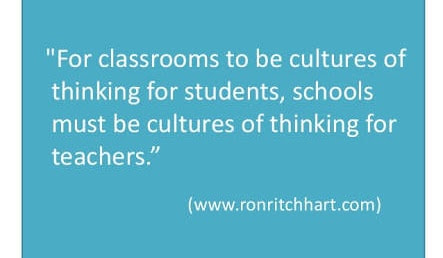
"Learning is a consequence of thinking, not something extra we tack on for good measure but something in which we must actively engage to promote our own and other's learning."
- Ron Ritchhart, Creating Cultures of Thinking (2015)
Education researchers, policy makers and private enterprise all agree that, in addition to content knowledge, students in the 21st Century need to acquire particular skills to equip them for a modern world, one of which is the ability to think - and think well.
The Australian Curriculum, including the adapted NSW Syllabus, recognises the importance of the development of these skills through the general capabilities that are developed across the whole curriculum. These curriculum's are detailed and articulate clearly the critical and creative thinking skills that a child needs to develop as they progress through school. How and where these skills are taught remains the decision of the school (ACER Teacher Magazine, 2015).
Picture
As educators, we want students to become proficient with the kinds of thinking they can use to develop their own understanding of things. For example, we want students in our schools to:
  • Ask questions, identify puzzles, and wonder about the mysteries and implications of the objects and ideas of learning.
  • Make connections, comparisons, and contrasts between and among things - including connections within and across the discipline as well as with one's own prior knowledge.
  • Build ongoing and evolving explanations, interpretations, and theories based on one's ever-developing knowledge and understanding.
  • Examine things from different perspectives and alternative points of view to discern bias and develop a more balanced take on issues, ideas and events.
  • Notice, observe and look closely to fully perceive details, nuances and hidden aspects and to observe what is really going on as the foundational evidence for one's interpretations and theories.
  • Identify, gather, and reason with evidence to justify and support one's interpretations, predictions, theories, arguments, and explanations.
  • Delve deeper to uncover the complexities and challenges of a topic and look below the surface of things, recognising when one has only a surface understanding.
  • Be able to capture the core or essence of a thing to discern what it is really all about.
(Ritchhart, 2015)

HOW CAN WE MAKE THINKING VISIBLE?


  1. QUESTIONING: Teachers can ask questions that model our interest in the ideas being explored; help students to construct understanding; and facilitate the illuminations of students' own thinking to themselves. Good questions, that is, questions that drive learning, don't come from some prescribed list or set of guidelines; they arise in response to students' contributions.
  2. LISTENING: Listening conveys a sense of respect for and interest in learner's contributions. Good questions arise in response to students' contributions - "It is one thing to ask good questions, but one also has to listen for the answers." As teachers, our listening to students provides a model for our students of what it means to listen.​
    3.  DOCUMENTING: Trying to capture the conversations, events, questions, acts; as a basis for reflecting on 
        one's learning and considering as an object for discussion. The process of documenting must serve
        to 
Advance Learning (over time) not just capture it. When teacher's capture students ideas, they are
        signalling that those ideas and thoughts have value and are worthy of continued exploration and
        examination. 
Documenting learning is a process that makes thinking about learning processes visible,
        meaningful, shareable and amplified. It facilitates student-driven leaning, helping students to reflect on
​        and articulate their own learning processes


When deep learning experiences are visible, valued and involve students directly in the documentation process, it enables them to identify moments worth remembering (Rosenthal Tolisano and Hale (2018)

HOW DOES JOHN HATTIE'S WORK ABOUT VISIBLE LEARNING RELATE TO RITCHHART'S 8 CULTURAL FORCES?
Learning is a process, not an event. Some things students only understand at the surface level, which is perfectly fine. You have to know something in order to be able to do something with it. With appropriate scaffolding and instruction on how to relate and extend ideas, surface learning becomes deep understanding. Deep understanding is important if students are going to set their own expectations and monitor their own achievements.

Learning demands that learners be able to
  • apply
  • transfer
their knowledge, skills and strategies to new situations.
-Fisher, Frey & Hattie (2016)

Picture
Please note that these pages contain a collection of resources and links to activities to support and enhance classroom teaching and learning. The thumbnails and activities are the property of the authors/creators and available due to their generosity in sharing their work. All sources are acknowledged on the ACKNOWLEDGEMENT OF SOURCES page.
This website contains NSW syllabus content prepared by the NSW Education Standards Authority for and on behalf of the State of New South Wales which is protected by Crown copyright.
https://www.educationstandards.nsw.edu.au/wps/portal/nesa/home 
​
This work is licensed under a Creative Commons Attribution-NonCommercial-ShareAlike 4.0 International License.
Picture
  • Home
  • Educational Resources
    • Thinking Routines >
      • Routines for Introducing & Exploring Ideas >
        • See Think Wonder
        • Think Puzzle Explore
        • Chalk Talk
        • Zoom In
        • 3 2 1 Bridge
        • Compass Points
        • The Explanation Game
        • Hot Spots
      • Routines for Synthesising & Organising Ideas >
        • Connect Extend Challenge
        • Colour Symbol Image
        • Headlines
        • I used to think...Now I Think
        • Generate Sort Connect Elaborate
        • The 4C's
        • The Microlab Protocol
        • E3
      • Routines for Digging Deeper into Ideas >
        • What Makes You Say That?
        • Circle of Viewpoints
        • Step Inside
        • Red Light Yellow Light
        • Claim Support Question
        • Tug-Of-War
        • Sentence Phrase Word
        • Peel The Fruit
        • Question Starts
        • Main Side Hidden
        • Layered Inference
      • Routines for Giving Feedback >
        • Give 3
        • Ladder of Feedback **NEW**
        • SAIL: Share Ask Ideas Learned **NEW**
      • Routines for Self Reflection >
        • Pause Points **NEW**
        • Success Criteria Strips **NEW**
        • Exit Ticket Questions
        • Traffic Light Reflection
        • Show of Thumbs Reflection
        • 3 2 1 Reflection
        • 4-Square Criterion Reflection
      • Routines for Engaging With Others **NEW** >
        • Give One Get One
        • +1
        • Think Talk Open Exchange
        • The Leaderless Discussion **NEW**
        • Making Meaning **NEW**
    • Cultures of Thinking >
      • Our Journey
      • Uncovering Student's Thinking
      • Building Understanding
      • 8 Cultural Forces >
        • Time
        • Routines
        • Language
        • Modeling
        • Opportunities
        • Interactions
        • Environment
        • Expectations
    • Inquiry-Based Learning >
      • Unpacking the Cycle of Inquiry **NEW**
      • The Art of Questioning **NEW**
      • Planning An Inqury Unit **NEW**
      • Genius Hour
    • Visible Learning >
      • Learning Intentions
      • Success Criteria
      • Feedback
      • 10 Mindframes for Visible Learning
    • Units of Work >
      • English >
        • Reading Resources >
          • Reading Conferences
          • Book Club
          • Visual Literacy
          • Book Review
        • Spelling Resources >
          • Spelling Through Inquiry
        • Grammar & Punctuation Resources
      • Mathematics >
        • Number & Algebra
        • Measurement & Geometry
        • Statistics & Probability
      • Science & Technology >
        • Earth and Space >
          • ES: Early Stage 1
          • ES: Stage 1
          • ES: Stage 2
          • ES: Stage 3
        • Material World >
          • MW: Stage 1
          • MW: Stage 2
          • MW: Stage 3
        • Living World >
          • LW: Early Stage 1
          • LW: Stage 1
          • LW: Stage 2
          • LW: Stage 3
        • Physical World >
          • PW: Stage Two
        • Digital Technologies >
          • DT: Stage 1
          • DT: Stage 2
          • DT: Stage 3
      • Geography >
        • S1: People and Places
        • S3: Factors That Shape Places
        • S3: A Diverse and Connected World
      • History >
        • The Australian Colonies
        • Australia As A Nation
      • Personal Development, Health & Physical Education >
        • PDHPE: YEAR 5
      • Other KLA's >
        • Creative Arts
        • ICT >
          • Google Apps For Education
  • Blog
  • SPEAKER
  • Podcasts
    • Teacher Takeaway Podcast
  • Books
    • The Thinking Classroom >
      • TTC Exclusive Content
    • The Learning Classroom >
      • TLC Exclusive Content
  • Shop
  • Courses
  • Contact
    • Acknowledgement of Sources