THINKING PATHWAYS
  • Home
  • Educational Resources
    • Thinking Routines >
      • Routines for Introducing & Exploring Ideas >
        • See Think Wonder
        • Think Puzzle Explore
        • Chalk Talk
        • Zoom In
        • 3 2 1 Bridge
        • Compass Points
        • The Explanation Game
        • Hot Spots
      • Routines for Synthesising & Organising Ideas >
        • Connect Extend Challenge
        • Colour Symbol Image
        • Headlines
        • I used to think...Now I Think
        • Generate Sort Connect Elaborate
        • The 4C's
        • The Microlab Protocol
        • E3
      • Routines for Digging Deeper into Ideas >
        • What Makes You Say That?
        • Circle of Viewpoints
        • Step Inside
        • Red Light Yellow Light
        • Claim Support Question
        • Tug-Of-War
        • Sentence Phrase Word
        • Peel The Fruit
        • Question Starts
        • Main Side Hidden
        • Layered Inference
      • Routines for Giving Feedback >
        • Give 3
        • Ladder of Feedback **NEW**
        • SAIL: Share Ask Ideas Learned **NEW**
      • Routines for Self Reflection >
        • Pause Points **NEW**
        • Success Criteria Strips **NEW**
        • Exit Ticket Questions
        • Traffic Light Reflection
        • Show of Thumbs Reflection
        • 3 2 1 Reflection
        • 4-Square Criterion Reflection
      • Routines for Engaging With Others **NEW** >
        • Give One Get One
        • +1
        • Think Talk Open Exchange
        • The Leaderless Discussion **NEW**
        • Making Meaning **NEW**
    • Cultures of Thinking >
      • Our Journey
      • Uncovering Student's Thinking
      • Building Understanding
      • 8 Cultural Forces >
        • Time
        • Routines
        • Language
        • Modeling
        • Opportunities
        • Interactions
        • Environment
        • Expectations
    • Inquiry-Based Learning >
      • Unpacking the Cycle of Inquiry **NEW**
      • The Art of Questioning **NEW**
      • Planning An Inqury Unit **NEW**
      • Genius Hour
    • Visible Learning >
      • Learning Intentions
      • Success Criteria
      • Feedback
      • 10 Mindframes for Visible Learning
    • Units of Work >
      • English >
        • Reading Resources >
          • Reading Conferences
          • Book Club
          • Visual Literacy
          • Book Review
        • Spelling Resources >
          • Spelling Through Inquiry
        • Grammar & Punctuation Resources
      • Mathematics >
        • Number & Algebra
        • Measurement & Geometry
        • Statistics & Probability
      • Science & Technology >
        • Earth and Space >
          • ES: Early Stage 1
          • ES: Stage 1
          • ES: Stage 2
          • ES: Stage 3
        • Material World >
          • MW: Stage 1
          • MW: Stage 2
          • MW: Stage 3
        • Living World >
          • LW: Early Stage 1
          • LW: Stage 1
          • LW: Stage 2
          • LW: Stage 3
        • Physical World >
          • PW: Stage Two
        • Digital Technologies >
          • DT: Stage 1
          • DT: Stage 2
          • DT: Stage 3
      • Geography >
        • S1: People and Places
        • S3: Factors That Shape Places
        • S3: A Diverse and Connected World
      • History >
        • The Australian Colonies
        • Australia As A Nation
      • Personal Development, Health & Physical Education >
        • PDHPE: YEAR 5
      • Other KLA's >
        • Creative Arts
        • ICT >
          • Google Apps For Education
  • Blog
  • SPEAKER
  • Podcasts
    • Teacher Takeaway Podcast
  • Books
    • The Thinking Classroom >
      • TTC Exclusive Content
    • The Learning Classroom >
      • TLC Exclusive Content
  • Shop
  • Courses
  • Contact
    • Acknowledgement of Sources

Learning Intentions

Learners tend to learn more effectively when they are clear about the purpose of learning. Knowing where you are headed does not mean that the tasks needs to have every single detail mapped out for you, but it does require a clarity of the purpose of learning. 

There is a multitude of research out there that confirms the value of sharing quality learning intentions with learners that clearly articulates what the teacher wants the students to know, understand and be able to do as a result of the learning. 

The intentions we have for students' learning should be clear. They should never be a secret or guess what's in the teacher's head. Kath Murdoch in her book The Power of Inquiry states that instead of documenting an intention as an inevitability - 'We will learn...' an inquiry teacher may pose the intention in the form of a question - 'How might we...' This then allows the learning intention to become transferable.

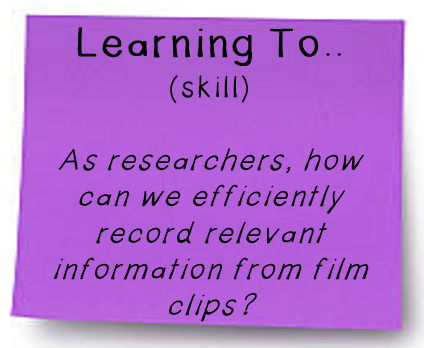
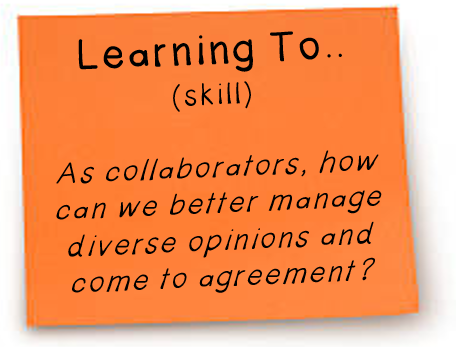
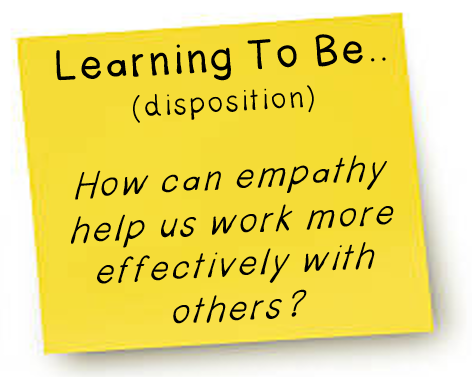
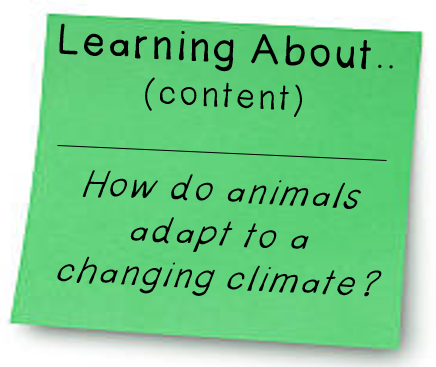
One effective strategy for sharing learning intentions, with learning assets as the focus, is to use Guy Claxton's split screen teaching approach. Creating a split screen learning intention reminds us all that we are continually focusing on learning to learn while we are learning about a concept or exploring a question. This highlights for all parties that learning is indeed layered and complex. For example:
Picture
Picture
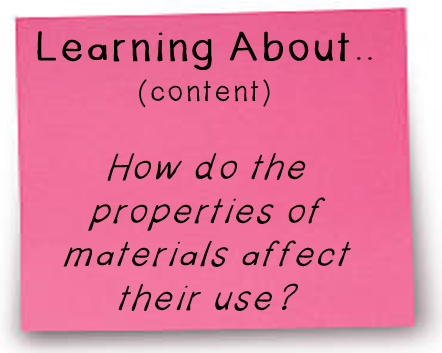
Or use a triple split screen that identifies the content, skills and dispositions central to the learning task. For example:
Picture
Picture
Picture

Why bother to include thinking dispositions in learning intentions?

However, I believe that we often miss a crucial element when we give students learning intentions and success criteria - THINKING! Where is the thinking we want students to use?? (see blog post)
​
We need to explain the type of thinking students are required to use during a learning task as well as highlight what a sound example of what this thinking looks like in order to be successful. This also means students need explicit guidance and practice in knowing how to think in different ways and be able to apply this to a variety of everyday situations. ​
Picture
When we introduce assignments, projects, or tasks to students we often lay out the logistics of the task. We describe the product that that will be created and how students will know when they are done. We might also supply grading criteria (in the form of a rubric or as success criteria) that let’s students know what we are looking for in their completed project.

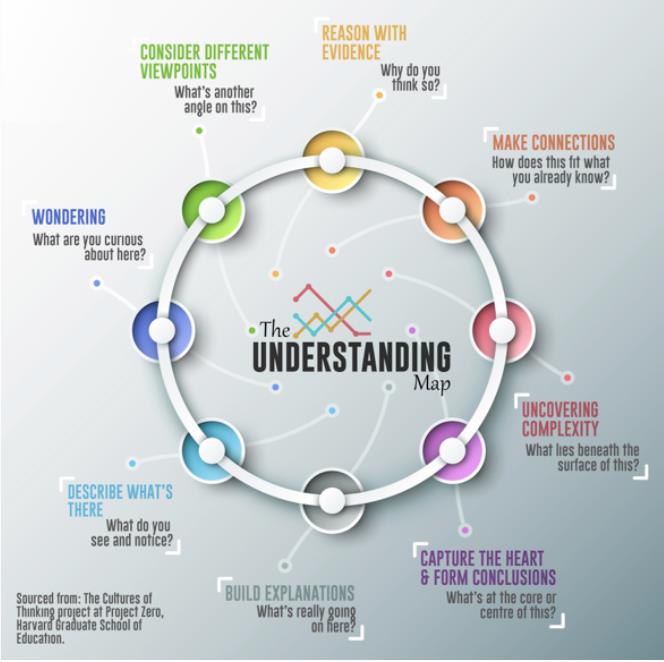
However, this approach risks focusing on the work to be done rather than the learning we hope will happen. To focus on the learning, we must also share with students what kinds of thinking they will be asked to do (see Understanding Map). If we can’t identify the thinking, or help students to identify it, we might have a task that is limited in its learning potential.
Picture
When learners feeling a sense of purpose in what they are doing, learning goes way up. However, establishing purpose is much more than stating a learning intention or objective.

​Helping learners feel a sense of purpose is an ongoing endeavor in which we situate work in a larger context that has meaning and where students feel like their accomplishing something that has worth in their own eyes, not just the teacher’s eyes.  
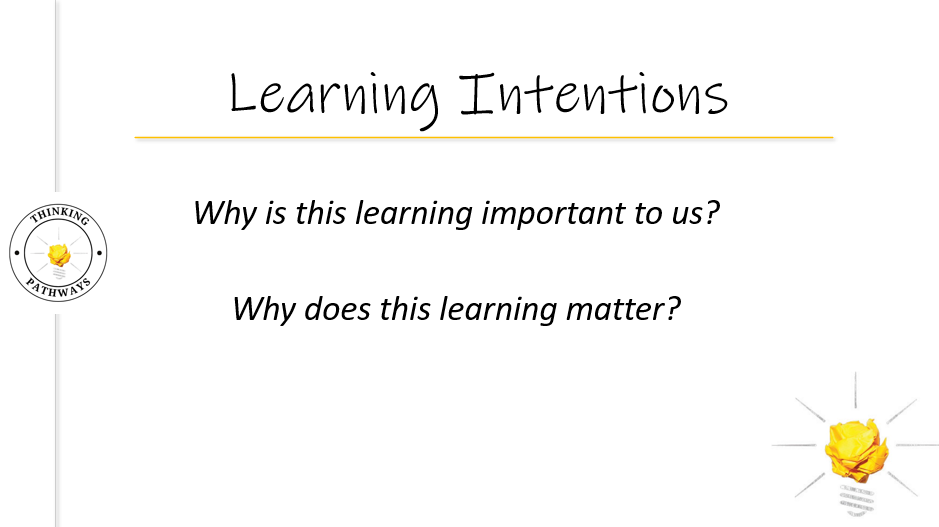
Read about the importance of Learning Intentions from AITSL below:
Picture
Click image for pdf
Picture
learning_intentions_and_success_criteria_presentation_.pdf
File Size: 2600 kb
File Type: pdf
Download File

Further Reading on Learning Intentions:

Kath Murdoch
​- The Question of Learning Intentions
NSW Education Standards Authority (NESA)
NSW Department of Education
On Butterfly Wings
Corwin - Larry Ainsworth Workshop Notes
Please note that these pages contain a collection of resources and links to activities to support and enhance classroom teaching and learning. The thumbnails and activities are the property of the authors/creators and available due to their generosity in sharing their work. All sources are acknowledged on the ACKNOWLEDGEMENT OF SOURCES page.
This website contains NSW syllabus content prepared by the NSW Education Standards Authority for and on behalf of the State of New South Wales which is protected by Crown copyright.
https://www.educationstandards.nsw.edu.au/wps/portal/nesa/home 
​
This work is licensed under a Creative Commons Attribution-NonCommercial-ShareAlike 4.0 International License.
Picture
  • Home
  • Educational Resources
    • Thinking Routines >
      • Routines for Introducing & Exploring Ideas >
        • See Think Wonder
        • Think Puzzle Explore
        • Chalk Talk
        • Zoom In
        • 3 2 1 Bridge
        • Compass Points
        • The Explanation Game
        • Hot Spots
      • Routines for Synthesising & Organising Ideas >
        • Connect Extend Challenge
        • Colour Symbol Image
        • Headlines
        • I used to think...Now I Think
        • Generate Sort Connect Elaborate
        • The 4C's
        • The Microlab Protocol
        • E3
      • Routines for Digging Deeper into Ideas >
        • What Makes You Say That?
        • Circle of Viewpoints
        • Step Inside
        • Red Light Yellow Light
        • Claim Support Question
        • Tug-Of-War
        • Sentence Phrase Word
        • Peel The Fruit
        • Question Starts
        • Main Side Hidden
        • Layered Inference
      • Routines for Giving Feedback >
        • Give 3
        • Ladder of Feedback **NEW**
        • SAIL: Share Ask Ideas Learned **NEW**
      • Routines for Self Reflection >
        • Pause Points **NEW**
        • Success Criteria Strips **NEW**
        • Exit Ticket Questions
        • Traffic Light Reflection
        • Show of Thumbs Reflection
        • 3 2 1 Reflection
        • 4-Square Criterion Reflection
      • Routines for Engaging With Others **NEW** >
        • Give One Get One
        • +1
        • Think Talk Open Exchange
        • The Leaderless Discussion **NEW**
        • Making Meaning **NEW**
    • Cultures of Thinking >
      • Our Journey
      • Uncovering Student's Thinking
      • Building Understanding
      • 8 Cultural Forces >
        • Time
        • Routines
        • Language
        • Modeling
        • Opportunities
        • Interactions
        • Environment
        • Expectations
    • Inquiry-Based Learning >
      • Unpacking the Cycle of Inquiry **NEW**
      • The Art of Questioning **NEW**
      • Planning An Inqury Unit **NEW**
      • Genius Hour
    • Visible Learning >
      • Learning Intentions
      • Success Criteria
      • Feedback
      • 10 Mindframes for Visible Learning
    • Units of Work >
      • English >
        • Reading Resources >
          • Reading Conferences
          • Book Club
          • Visual Literacy
          • Book Review
        • Spelling Resources >
          • Spelling Through Inquiry
        • Grammar & Punctuation Resources
      • Mathematics >
        • Number & Algebra
        • Measurement & Geometry
        • Statistics & Probability
      • Science & Technology >
        • Earth and Space >
          • ES: Early Stage 1
          • ES: Stage 1
          • ES: Stage 2
          • ES: Stage 3
        • Material World >
          • MW: Stage 1
          • MW: Stage 2
          • MW: Stage 3
        • Living World >
          • LW: Early Stage 1
          • LW: Stage 1
          • LW: Stage 2
          • LW: Stage 3
        • Physical World >
          • PW: Stage Two
        • Digital Technologies >
          • DT: Stage 1
          • DT: Stage 2
          • DT: Stage 3
      • Geography >
        • S1: People and Places
        • S3: Factors That Shape Places
        • S3: A Diverse and Connected World
      • History >
        • The Australian Colonies
        • Australia As A Nation
      • Personal Development, Health & Physical Education >
        • PDHPE: YEAR 5
      • Other KLA's >
        • Creative Arts
        • ICT >
          • Google Apps For Education
  • Blog
  • SPEAKER
  • Podcasts
    • Teacher Takeaway Podcast
  • Books
    • The Thinking Classroom >
      • TTC Exclusive Content
    • The Learning Classroom >
      • TLC Exclusive Content
  • Shop
  • Courses
  • Contact
    • Acknowledgement of Sources