THINKING PATHWAYS
  • Home
  • Educational Resources
    • Thinking Routines >
      • Routines for Introducing & Exploring Ideas >
        • See Think Wonder
        • Think Puzzle Explore
        • Chalk Talk
        • Zoom In
        • 3 2 1 Bridge
        • Compass Points
        • The Explanation Game
        • Hot Spots
      • Routines for Synthesising & Organising Ideas >
        • Connect Extend Challenge
        • Colour Symbol Image
        • Headlines
        • I used to think...Now I Think
        • Generate Sort Connect Elaborate
        • The 4C's
        • The Microlab Protocol
        • E3
      • Routines for Digging Deeper into Ideas >
        • What Makes You Say That?
        • Circle of Viewpoints
        • Step Inside
        • Red Light Yellow Light
        • Claim Support Question
        • Tug-Of-War
        • Sentence Phrase Word
        • Peel The Fruit
        • Question Starts
        • Main Side Hidden
        • Layered Inference
      • Routines for Giving Feedback >
        • Give 3
        • Ladder of Feedback **NEW**
        • SAIL: Share Ask Ideas Learned **NEW**
      • Routines for Self Reflection >
        • Pause Points **NEW**
        • Success Criteria Strips **NEW**
        • Exit Ticket Questions
        • Traffic Light Reflection
        • Show of Thumbs Reflection
        • 3 2 1 Reflection
        • 4-Square Criterion Reflection
      • Routines for Engaging With Others **NEW** >
        • Give One Get One
        • +1
        • Think Talk Open Exchange
        • The Leaderless Discussion **NEW**
        • Making Meaning **NEW**
    • Cultures of Thinking >
      • Our Journey
      • Uncovering Student's Thinking
      • Building Understanding
      • 8 Cultural Forces >
        • Time
        • Routines
        • Language
        • Modeling
        • Opportunities
        • Interactions
        • Environment
        • Expectations
    • Inquiry-Based Learning >
      • Unpacking the Cycle of Inquiry **NEW**
      • The Art of Questioning **NEW**
      • Planning An Inqury Unit **NEW**
      • Genius Hour
    • Visible Learning >
      • Learning Intentions
      • Success Criteria
      • Feedback
      • 10 Mindframes for Visible Learning
    • Units of Work >
      • English >
        • Reading Resources >
          • Reading Conferences
          • Book Club
          • Visual Literacy
          • Book Review
        • Spelling Resources >
          • Spelling Through Inquiry
        • Grammar & Punctuation Resources
      • Mathematics >
        • Number & Algebra
        • Measurement & Geometry
        • Statistics & Probability
      • Science & Technology >
        • Earth and Space >
          • ES: Early Stage 1
          • ES: Stage 1
          • ES: Stage 2
          • ES: Stage 3
        • Material World >
          • MW: Stage 1
          • MW: Stage 2
          • MW: Stage 3
        • Living World >
          • LW: Early Stage 1
          • LW: Stage 1
          • LW: Stage 2
          • LW: Stage 3
        • Physical World >
          • PW: Stage Two
        • Digital Technologies >
          • DT: Stage 1
          • DT: Stage 2
          • DT: Stage 3
      • Geography >
        • S1: People and Places
        • S3: Factors That Shape Places
        • S3: A Diverse and Connected World
      • History >
        • The Australian Colonies
        • Australia As A Nation
      • Personal Development, Health & Physical Education >
        • PDHPE: YEAR 5
      • Other KLA's >
        • Creative Arts
        • ICT >
          • Google Apps For Education
  • Blog
  • SPEAKER
  • Podcasts
    • Teacher Takeaway Podcast
  • Books
    • The Thinking Classroom >
      • TTC Exclusive Content
    • The Learning Classroom >
      • TLC Exclusive Content
  • Shop
  • Courses
  • Contact
    • Acknowledgement of Sources

Planning An Inquiry Unit

How can we build a high-quality and engaging Inquiry unit?

When educators first begin on the inquiry learning journey, it can feel overwhelming when you begin the process of planning a unit of inquiry. Here are a series of questioning prompts and programming examples that will support you as you engage with each phase of the inquiry planning process. 

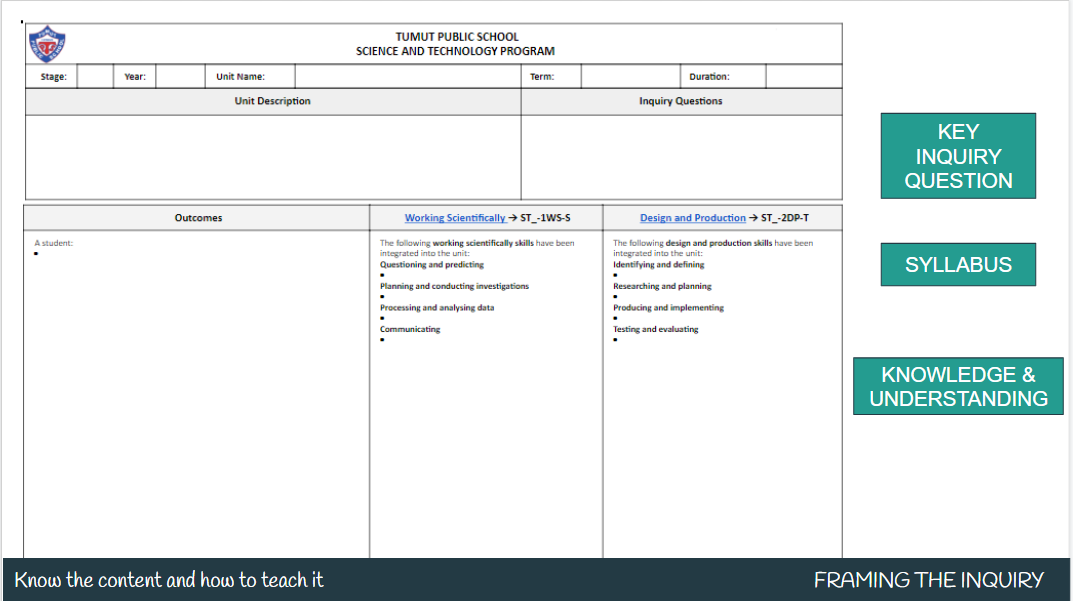
Framing the inquiry:

Framing the inquiry is an essential part of knowing the content and how to teach it (Australian Professional Standards for Teachers - standard 2). These question prompts will help you to map out the big ideas of the inquiry unit and help you to examine the key concepts present in this unit, e.g. sustainability. 
Syllabus and Cross-Curriculum Links:
  • What outcomes do I need to address?
  • What are the cross-curriculum priorities & general capabilities addressed in this unit?
  • What opportunities are there for harnessing other KLAs to build a broader picture of learning?
​Knowledge, Understanding and Skills:
  • What key content do I want my students to know and understand?
  • What skills do I want them to be able to demonstrate?
  • ​What are the key concepts embedded throughout this inquiry? 
Key Inquiry Questions:
  • What essential questions will be explored?
  • Why are these important?
Assessment:
  • How will I know they have achieved the outcomes?
  • How will I use assessment for, as and of throughout the learning process?
  • What products of learning will be used to assess knowledge, understanding, skills and thinking?
Feedback:
  • What feedback will be given during the different phases of the inquiry?
  • How can I promote self-regulation through feedback?
Picture
Picture

Brainstorming Experiences:

Once educators have a good understanding of the curriculum requirements, cross-curriculum connections that can be made and have a strong understanding of the key concepts to be explored in the unit, educators can begin brainstorming and sorting ideas for learning experiences and assessments that will help them achieve the learning goals and answer the key inquiry question(s). This process supports educators as they plan for and implement effective teaching and learning (Australian Professional Standards for Teachers - standard 3), and includes brainstorming about:
Content:
  • What are the big ideas and key themes?
Learning Experiences:
  • What kind of experiences might help students understand this content, concepts and answer the essential questions?
  • ​What opportunities might there be for authentic action?
​Learning Products:
  • ​How will I get them to show their thinking, understanding, knowledge and skills?

Tuning In:

Tuning In to the inquiry is a key part of knowing the students and how they learn as well as planning for and implementing effective teaching and learning (Australian Professional Standards for Teachers - standard 1 & 3). This phase is a crucial part of understanding where students are in the learning journey, where they need to head, what they wonder and deciding how we will get to that understanding. 
  • What will I use to spark interest and curiosity in this inquiry? 
    • Picture
    • Animation
    • Text
    • Artefact
    • A question
  • ​How will I activate prior knowledge and make that visible so as to reveal thinking and misconceptions?
 
  • How will I gather and record student wonderings? 
  • ​How will I link this provocation to the key inquiry question?
  • At what other stages of our inquiry might I need to tune students in to the learning experiences?​

Shared Inquiry & Reflection:

Shared Inquiry and Reflection is a crucial component of planning for and implementing effective teaching and learning, as well as assessing, providing feddback and reporting on student learning (Australian Professional Standards for Teachers - standard 3 & 5). This phase is crucial to helping students build the necessary skills to find and sort out information, making connections and diving deeper into the core concepts of the inquiry.
  • What learning experiences will help my students FIND OUT and SORT OUT?
  • ​How can I integrate other Key Learning Areas to support students to understand the content and answer the key inquiry question? -rich opportunities for Literacy and Numeracy 
  • How will I utilise student questions to shape the way our inquiry goes? 
  • How will we reflect on learning as we go? - Assessment As Learning & Goal Setting
  • What learning experiences will I use to monitor student thinking and understanding?
  • How can I be deliberate about the types of questions I am asking?
  • How will we document our learning? What will we do with this as our learning progresses?
  • How will I provide effective feedback for students throughout the process?

Going Further:

Going Further is a crucial component of planning for and implementing effective teaching and learning (Australian Professional Standards for Teachers - standard 3). This phase is about providing structured and meaningful opportunities for students to dig a bit deeper with key concepts and explore wonderings further. 
  • What opportunities are there for students to take learning further?
  • What opportunities are there for students to engage with and find solutions for authentic real-world problems?
  • How will these enhance student learning and understanding?


Programming Samples:

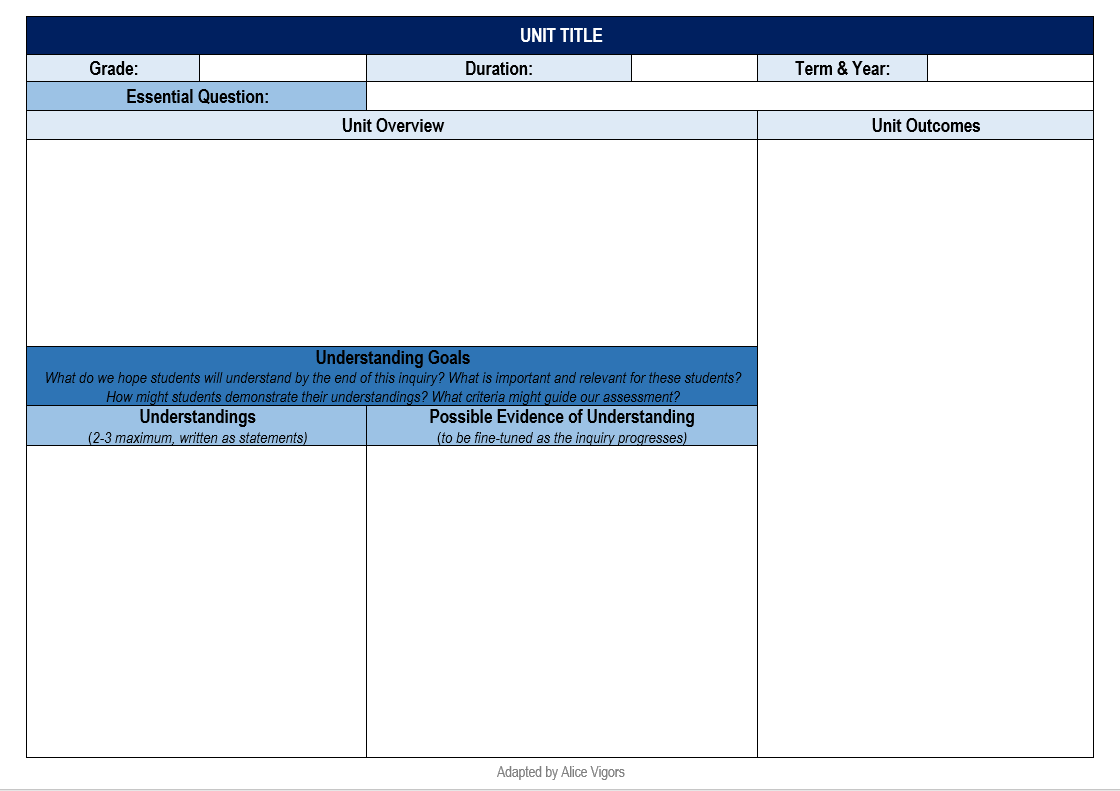
Below you will find a link to an example inquiry template that you can use or adapt to suit the needs of your own educational context. This planning template is useful for compliance and collaborative planning purposes and is an ongoing and evolving document as the inquiry unit progresses. 
Picture
Click template image for a copy of the document
Please note that these pages contain a collection of resources and links to activities to support and enhance classroom teaching and learning. The thumbnails and activities are the property of the authors/creators and available due to their generosity in sharing their work. All sources are acknowledged on the ACKNOWLEDGEMENT OF SOURCES page.
This website contains NSW syllabus content prepared by the NSW Education Standards Authority for and on behalf of the State of New South Wales which is protected by Crown copyright.
https://www.educationstandards.nsw.edu.au/wps/portal/nesa/home 
​
This work is licensed under a Creative Commons Attribution-NonCommercial-ShareAlike 4.0 International License.
Picture
  • Home
  • Educational Resources
    • Thinking Routines >
      • Routines for Introducing & Exploring Ideas >
        • See Think Wonder
        • Think Puzzle Explore
        • Chalk Talk
        • Zoom In
        • 3 2 1 Bridge
        • Compass Points
        • The Explanation Game
        • Hot Spots
      • Routines for Synthesising & Organising Ideas >
        • Connect Extend Challenge
        • Colour Symbol Image
        • Headlines
        • I used to think...Now I Think
        • Generate Sort Connect Elaborate
        • The 4C's
        • The Microlab Protocol
        • E3
      • Routines for Digging Deeper into Ideas >
        • What Makes You Say That?
        • Circle of Viewpoints
        • Step Inside
        • Red Light Yellow Light
        • Claim Support Question
        • Tug-Of-War
        • Sentence Phrase Word
        • Peel The Fruit
        • Question Starts
        • Main Side Hidden
        • Layered Inference
      • Routines for Giving Feedback >
        • Give 3
        • Ladder of Feedback **NEW**
        • SAIL: Share Ask Ideas Learned **NEW**
      • Routines for Self Reflection >
        • Pause Points **NEW**
        • Success Criteria Strips **NEW**
        • Exit Ticket Questions
        • Traffic Light Reflection
        • Show of Thumbs Reflection
        • 3 2 1 Reflection
        • 4-Square Criterion Reflection
      • Routines for Engaging With Others **NEW** >
        • Give One Get One
        • +1
        • Think Talk Open Exchange
        • The Leaderless Discussion **NEW**
        • Making Meaning **NEW**
    • Cultures of Thinking >
      • Our Journey
      • Uncovering Student's Thinking
      • Building Understanding
      • 8 Cultural Forces >
        • Time
        • Routines
        • Language
        • Modeling
        • Opportunities
        • Interactions
        • Environment
        • Expectations
    • Inquiry-Based Learning >
      • Unpacking the Cycle of Inquiry **NEW**
      • The Art of Questioning **NEW**
      • Planning An Inqury Unit **NEW**
      • Genius Hour
    • Visible Learning >
      • Learning Intentions
      • Success Criteria
      • Feedback
      • 10 Mindframes for Visible Learning
    • Units of Work >
      • English >
        • Reading Resources >
          • Reading Conferences
          • Book Club
          • Visual Literacy
          • Book Review
        • Spelling Resources >
          • Spelling Through Inquiry
        • Grammar & Punctuation Resources
      • Mathematics >
        • Number & Algebra
        • Measurement & Geometry
        • Statistics & Probability
      • Science & Technology >
        • Earth and Space >
          • ES: Early Stage 1
          • ES: Stage 1
          • ES: Stage 2
          • ES: Stage 3
        • Material World >
          • MW: Stage 1
          • MW: Stage 2
          • MW: Stage 3
        • Living World >
          • LW: Early Stage 1
          • LW: Stage 1
          • LW: Stage 2
          • LW: Stage 3
        • Physical World >
          • PW: Stage Two
        • Digital Technologies >
          • DT: Stage 1
          • DT: Stage 2
          • DT: Stage 3
      • Geography >
        • S1: People and Places
        • S3: Factors That Shape Places
        • S3: A Diverse and Connected World
      • History >
        • The Australian Colonies
        • Australia As A Nation
      • Personal Development, Health & Physical Education >
        • PDHPE: YEAR 5
      • Other KLA's >
        • Creative Arts
        • ICT >
          • Google Apps For Education
  • Blog
  • SPEAKER
  • Podcasts
    • Teacher Takeaway Podcast
  • Books
    • The Thinking Classroom >
      • TTC Exclusive Content
    • The Learning Classroom >
      • TLC Exclusive Content
  • Shop
  • Courses
  • Contact
    • Acknowledgement of Sources