THINKING PATHWAYS
  • Home
  • Educational Resources
    • Thinking Routines >
      • Routines for Introducing & Exploring Ideas >
        • See Think Wonder
        • Think Puzzle Explore
        • Chalk Talk
        • Zoom In
        • 3 2 1 Bridge
        • Compass Points
        • The Explanation Game
        • Hot Spots
      • Routines for Synthesising & Organising Ideas >
        • Connect Extend Challenge
        • Colour Symbol Image
        • Headlines
        • I used to think...Now I Think
        • Generate Sort Connect Elaborate
        • The 4C's
        • The Microlab Protocol
        • E3
      • Routines for Digging Deeper into Ideas >
        • What Makes You Say That?
        • Circle of Viewpoints
        • Step Inside
        • Red Light Yellow Light
        • Claim Support Question
        • Tug-Of-War
        • Sentence Phrase Word
        • Peel The Fruit
        • Question Starts
        • Main Side Hidden
        • Layered Inference
      • Routines for Giving Feedback >
        • Give 3
        • Ladder of Feedback **NEW**
        • SAIL: Share Ask Ideas Learned **NEW**
      • Routines for Self Reflection >
        • Pause Points **NEW**
        • Success Criteria Strips **NEW**
        • Exit Ticket Questions
        • Traffic Light Reflection
        • Show of Thumbs Reflection
        • 3 2 1 Reflection
        • 4-Square Criterion Reflection
      • Routines for Engaging With Others **NEW** >
        • Give One Get One
        • +1
        • Think Talk Open Exchange
        • The Leaderless Discussion **NEW**
        • Making Meaning **NEW**
    • Cultures of Thinking >
      • Our Journey
      • Uncovering Student's Thinking
      • Building Understanding
      • 8 Cultural Forces >
        • Time
        • Routines
        • Language
        • Modeling
        • Opportunities
        • Interactions
        • Environment
        • Expectations
    • Inquiry-Based Learning >
      • Unpacking the Cycle of Inquiry **NEW**
      • The Art of Questioning **NEW**
      • Planning An Inqury Unit **NEW**
      • Genius Hour
    • Visible Learning >
      • Learning Intentions
      • Success Criteria
      • Feedback
      • 10 Mindframes for Visible Learning
    • Units of Work >
      • English >
        • Reading Resources >
          • Reading Conferences
          • Book Club
          • Visual Literacy
          • Book Review
        • Spelling Resources >
          • Spelling Through Inquiry
        • Grammar & Punctuation Resources
      • Mathematics >
        • Number & Algebra
        • Measurement & Geometry
        • Statistics & Probability
      • Science & Technology >
        • Earth and Space >
          • ES: Early Stage 1
          • ES: Stage 1
          • ES: Stage 2
          • ES: Stage 3
        • Material World >
          • MW: Stage 1
          • MW: Stage 2
          • MW: Stage 3
        • Living World >
          • LW: Early Stage 1
          • LW: Stage 1
          • LW: Stage 2
          • LW: Stage 3
        • Physical World >
          • PW: Stage Two
        • Digital Technologies >
          • DT: Stage 1
          • DT: Stage 2
          • DT: Stage 3
      • Geography >
        • S1: People and Places
        • S3: Factors That Shape Places
        • S3: A Diverse and Connected World
      • History >
        • The Australian Colonies
        • Australia As A Nation
      • Personal Development, Health & Physical Education >
        • PDHPE: YEAR 5
      • Other KLA's >
        • Creative Arts
        • ICT >
          • Google Apps For Education
  • Blog
  • SPEAKER
  • Podcasts
    • Teacher Takeaway Podcast
  • Books
    • The Thinking Classroom >
      • TTC Exclusive Content
    • The Learning Classroom >
      • TLC Exclusive Content
  • Shop
  • Courses
  • Contact
    • Acknowledgement of Sources

ROUTINES

THINKING ROUTINES
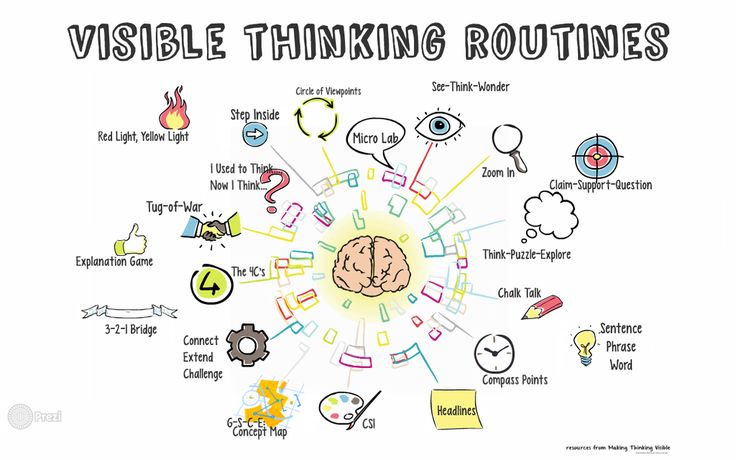
A thinking routine is more than a good one-off activity.
-Ron Ritchhart
Routines exist in all classrooms; they are the patterns by which we operate and go about the job of learning and working together in a classroom environment. A routine can be thought of as any procedure, process, or pattern of action that is used repeatedly to manage and facilitate the accomplishment of specific goals or tasks.
Thinking routines provide structures and scaffolds that must be deliberately activated, by the teacher at first (initial phase) and over time by the learner (developing phase), and then consciously deployed to achieve a goal (advanced phase). 
They are simple structures, for example a set of questions or a short sequence of steps, that can be used across various grade levels and curriculum areas. What makes them routines, as opposed to a strategy, is that they get used over and over again in the classroom so that they become ingrained and part of the classroom culture.
Picture

Take a listen to Jodi Yeloushan talk about using thinking routines and developing a culture of thinking. The video then takes a look at Year 4 teacher Karen Kumon using the Zoom In routine. 
Ron Ritchhart explains that when working to cultivate a culture of thinking within schools, we often begin with thinking routines as an entry point. This is not because they are the most important cultural force but because they:
  • help direct attention straight to the issue
  • provide specific practices that can easily be employed
  • make student thinking visible
  • provide a good platform to show what students are capable of doing
  • encourage action and discussion around thinking
  • connect easily to the other cultural forces 
Picture
As you begin to use thinking routines to scaffold student thinking you may notice that the other cultural forces come into play also.

For example, a teacher may notice changes in their language and the way they begin to scaffold other learning experiences. This flows on to the creation of opportunities and in their interactions etc. 
Go to Thinking Routines
Back: Time
Next: Language
Please note that these pages contain a collection of resources and links to activities to support and enhance classroom teaching and learning. The thumbnails and activities are the property of the authors/creators and available due to their generosity in sharing their work. All sources are acknowledged on the ACKNOWLEDGEMENT OF SOURCES page.
This website contains NSW syllabus content prepared by the NSW Education Standards Authority for and on behalf of the State of New South Wales which is protected by Crown copyright.
https://www.educationstandards.nsw.edu.au/wps/portal/nesa/home 
​
This work is licensed under a Creative Commons Attribution-NonCommercial-ShareAlike 4.0 International License.
Picture
  • Home
  • Educational Resources
    • Thinking Routines >
      • Routines for Introducing & Exploring Ideas >
        • See Think Wonder
        • Think Puzzle Explore
        • Chalk Talk
        • Zoom In
        • 3 2 1 Bridge
        • Compass Points
        • The Explanation Game
        • Hot Spots
      • Routines for Synthesising & Organising Ideas >
        • Connect Extend Challenge
        • Colour Symbol Image
        • Headlines
        • I used to think...Now I Think
        • Generate Sort Connect Elaborate
        • The 4C's
        • The Microlab Protocol
        • E3
      • Routines for Digging Deeper into Ideas >
        • What Makes You Say That?
        • Circle of Viewpoints
        • Step Inside
        • Red Light Yellow Light
        • Claim Support Question
        • Tug-Of-War
        • Sentence Phrase Word
        • Peel The Fruit
        • Question Starts
        • Main Side Hidden
        • Layered Inference
      • Routines for Giving Feedback >
        • Give 3
        • Ladder of Feedback **NEW**
        • SAIL: Share Ask Ideas Learned **NEW**
      • Routines for Self Reflection >
        • Pause Points **NEW**
        • Success Criteria Strips **NEW**
        • Exit Ticket Questions
        • Traffic Light Reflection
        • Show of Thumbs Reflection
        • 3 2 1 Reflection
        • 4-Square Criterion Reflection
      • Routines for Engaging With Others **NEW** >
        • Give One Get One
        • +1
        • Think Talk Open Exchange
        • The Leaderless Discussion **NEW**
        • Making Meaning **NEW**
    • Cultures of Thinking >
      • Our Journey
      • Uncovering Student's Thinking
      • Building Understanding
      • 8 Cultural Forces >
        • Time
        • Routines
        • Language
        • Modeling
        • Opportunities
        • Interactions
        • Environment
        • Expectations
    • Inquiry-Based Learning >
      • Unpacking the Cycle of Inquiry **NEW**
      • The Art of Questioning **NEW**
      • Planning An Inqury Unit **NEW**
      • Genius Hour
    • Visible Learning >
      • Learning Intentions
      • Success Criteria
      • Feedback
      • 10 Mindframes for Visible Learning
    • Units of Work >
      • English >
        • Reading Resources >
          • Reading Conferences
          • Book Club
          • Visual Literacy
          • Book Review
        • Spelling Resources >
          • Spelling Through Inquiry
        • Grammar & Punctuation Resources
      • Mathematics >
        • Number & Algebra
        • Measurement & Geometry
        • Statistics & Probability
      • Science & Technology >
        • Earth and Space >
          • ES: Early Stage 1
          • ES: Stage 1
          • ES: Stage 2
          • ES: Stage 3
        • Material World >
          • MW: Stage 1
          • MW: Stage 2
          • MW: Stage 3
        • Living World >
          • LW: Early Stage 1
          • LW: Stage 1
          • LW: Stage 2
          • LW: Stage 3
        • Physical World >
          • PW: Stage Two
        • Digital Technologies >
          • DT: Stage 1
          • DT: Stage 2
          • DT: Stage 3
      • Geography >
        • S1: People and Places
        • S3: Factors That Shape Places
        • S3: A Diverse and Connected World
      • History >
        • The Australian Colonies
        • Australia As A Nation
      • Personal Development, Health & Physical Education >
        • PDHPE: YEAR 5
      • Other KLA's >
        • Creative Arts
        • ICT >
          • Google Apps For Education
  • Blog
  • SPEAKER
  • Podcasts
    • Teacher Takeaway Podcast
  • Books
    • The Thinking Classroom >
      • TTC Exclusive Content
    • The Learning Classroom >
      • TLC Exclusive Content
  • Shop
  • Courses
  • Contact
    • Acknowledgement of Sources